

Virtual reality gaming has reached a tipping point in 2026. After years of clunky headsets and limited game libraries, we’re finally seeing devices that deliver true immersion without compromise. The latest generation of VR headsets offers 4K per eye resolution, sub-20ms latency, and battery life that actually lasts through extended gaming sessions.
Two titans dominate this space: Meta’s Quest 4, launching at $499, and Apple’s Vision Pro 2, priced at $2,499. But these flagship devices face serious competition from newcomers like ByteDance’s Pico 5 and Sony’s PlayStation VR3. Each targets different gaming audiences, from casual social gamers to hardcore enthusiasts chasing photorealistic experiences.
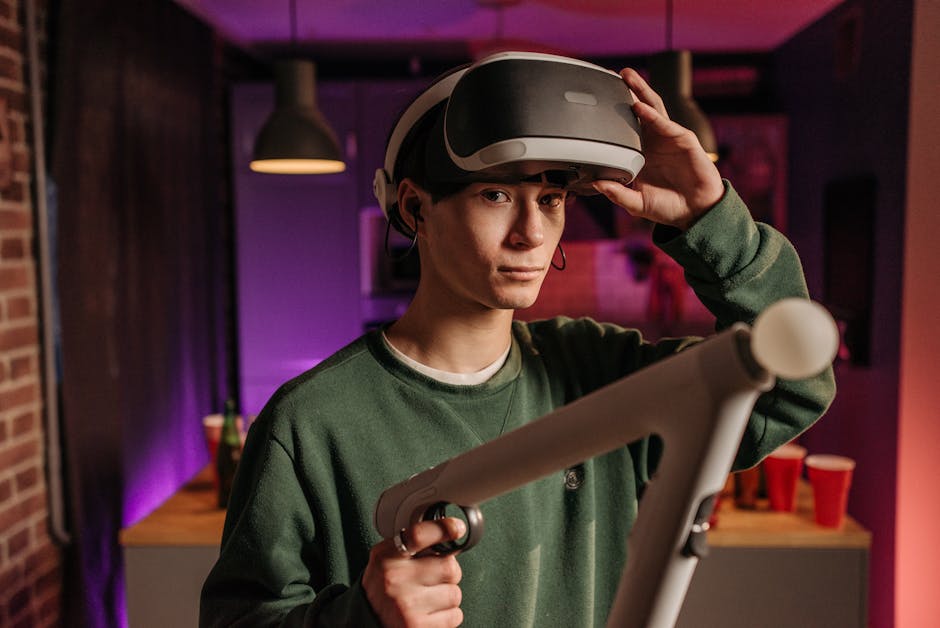
Flagship Contenders: Quest 4 vs Vision Pro 2
Meta Quest 4: The People’s Champion
Meta’s Quest 4 proves that premium VR doesn’t require a premium price. The headset packs Qualcomm’s Snapdragon XR3 Gen 2 processor, delivering 90% better performance than its predecessor while maintaining the same $499 launch price. The pancake lenses now offer a 120-degree field of view with minimal distortion, addressing the Quest 3’s edge clarity issues.
Gaming performance impresses across the board. *Assassin’s Creed: Nexus VR* runs at a locked 90fps on High settings, while *Beat Saber* maintains its signature responsiveness at 120fps. The new hand tracking system eliminates controller lag entirely – you can grab virtual objects with the same precision as real ones.
Battery life extends to 3.5 hours during intensive gaming, thanks to the more efficient processor and redesigned thermal management. The adjustable strap distribution system fits heads from the 5th to 95th percentile without pressure points, solving the comfort complaints that plagued earlier models.
Apple Vision Pro 2: Luxury Redefined
Apple’s Vision Pro 2 targets an entirely different market segment. At $2,499, it’s positioned as the ultimate mixed reality gaming machine. The dual M4 chips deliver desktop-class performance, enabling experiences impossible on mobile processors.
*Half-Life: Alyx Director’s Cut* showcases the hardware’s capabilities, rendering at native 4K per eye with raytraced reflections and volumetric lighting. The eye tracking system adjusts foveated rendering in real-time, maintaining visual fidelity where you’re looking while optimizing performance in peripheral vision.
The standout feature remains spatial computing integration. Games like *Civilization VII: AR Edition* overlay strategy elements onto your actual room, turning your coffee table into a battlefield. The precision passthrough cameras create seamless mixed reality experiences that feel magical rather than gimmicky.
However, the weight remains an issue at 650 grams – 40% heavier than the Quest 4. Gaming sessions beyond 90 minutes become uncomfortable despite the premium materials and engineering.
Mid-Range Champions and Budget Options
Sony PlayStation VR3: Console Gaming Evolved
Sony’s PlayStation VR3 launches alongside the PS6 at $399, exclusively targeting console gamers. The headset connects via a single USB-C cable, eliminating the breakout box that complicated previous generations. Integration with the PS6’s custom AMD RDNA 4 GPU enables exclusive features like hardware-accelerated ray tracing in VR.
*Gran Turismo 8 VR* demonstrates the platform’s potential, delivering photorealistic racing at 120fps with haptic feedback that simulates road texture through the steering wheel. The exclusive game library includes VR modes for major franchises: *Spider-Man: Miles Morales VR*, *God of War: Ragnarök VR*, and *The Last of Us Part III VR*.
The OLED displays produce deeper blacks than any competitor, crucial for horror games like *Resident Evil 9 VR*. However, the tethered design limits room-scale movement compared to standalone headsets.
ByteDance Pico 5: The Dark Horse
ByteDance’s Pico 5 arrives at $329, undercutting established players with impressive specifications. The MediaTek Dimensity XR1 processor approaches Quest 4 performance levels while supporting TikTok’s social VR platform natively.
*Pico Worlds* creates persistent virtual spaces where friends gather for gaming sessions. The integration feels organic – jump from watching TikTok videos together to playing *Among Us VR* without switching apps. Chinese developers have embraced the platform enthusiastically, creating unique experiences unavailable elsewhere.
Build quality matches more expensive competitors. The 110-degree field of view and 2880×2880 per eye resolution deliver sharp visuals, while the 400-gram weight enables extended comfort. The main limitation remains the smaller Western game library, though major publishers are announcing Pico support throughout 2026.

Budget Heroes and Specialized Solutions
HTC Vive XR Elite: Professional Gaming
HTC targets simulation enthusiasts with the Vive XR Elite at $799. The modular design allows users to swap between standalone and PC-tethered modes depending on the application. Flight simulation games like *Microsoft Flight Simulator VR* benefit from the PC connection, accessing full desktop graphics power.
The 130-degree field of view creates unprecedented immersion in cockpit games. Professional racing drivers use the headset for training, citing its accurate depth perception and minimal motion sickness. The adjustable IPD mechanism accommodates users from 54mm to 74mm, the widest range in the market.
Valve Deckard: Steam Integration Perfected
Valve’s long-awaited Deckard headset launches at $649, emphasizing Steam integration above all else. The custom Linux-based OS runs Steam VR games natively while maintaining compatibility with SteamOS gaming on Steam Deck.
*Counter-Strike 3 VR* becomes the killer app, translating the classic competitive shooter into room-scale VR. The 144Hz display refresh rate eliminates motion blur during fast movements, crucial for competitive gaming. Professional esports leagues announce VR divisions specifically for Valve’s ecosystem.
Budget Options: Reality Check
Budget headsets under $200 improve dramatically in 2026. The Oculus Go 3 delivers 1080p per eye gaming at $149, while Chinese manufacturer XReal offers the Air 2 at $199 with respectable 90Hz refresh rates.
These devices handle casual gaming well – *Angry Birds VR*, mobile puzzle games, and basic fitness applications. However, they struggle with demanding titles and lack the tracking precision required for competitive gaming.
The Verdict: Choose Your Adventure
Your ideal VR headset depends entirely on your gaming priorities and budget. The Meta Quest 4 offers the best balance of performance, price, and game library for most users. Its $499 price point makes high-quality VR accessible without sacrificing essential features.
Apple’s Vision Pro 2 justifies its premium pricing for users demanding cutting-edge mixed reality experiences and unlimited budgets. The spatial computing features create genuinely novel gaming possibilities, though the weight and cost limit its mass appeal.
Console gamers should consider the PlayStation VR3’s exclusive titles and seamless PS6 integration. PC enthusiasts chasing maximum visual fidelity will prefer the HTC Vive XR Elite’s flexibility and wide field of view.
The VR gaming landscape finally offers genuine choice in 2026. Whether you’re spending $149 or $2,499, you’ll find a headset capable of delivering memorable gaming experiences. The technology has matured – now it’s about finding the right fit for your gaming style.